Beverly Glen
Nuff said

Nuff said

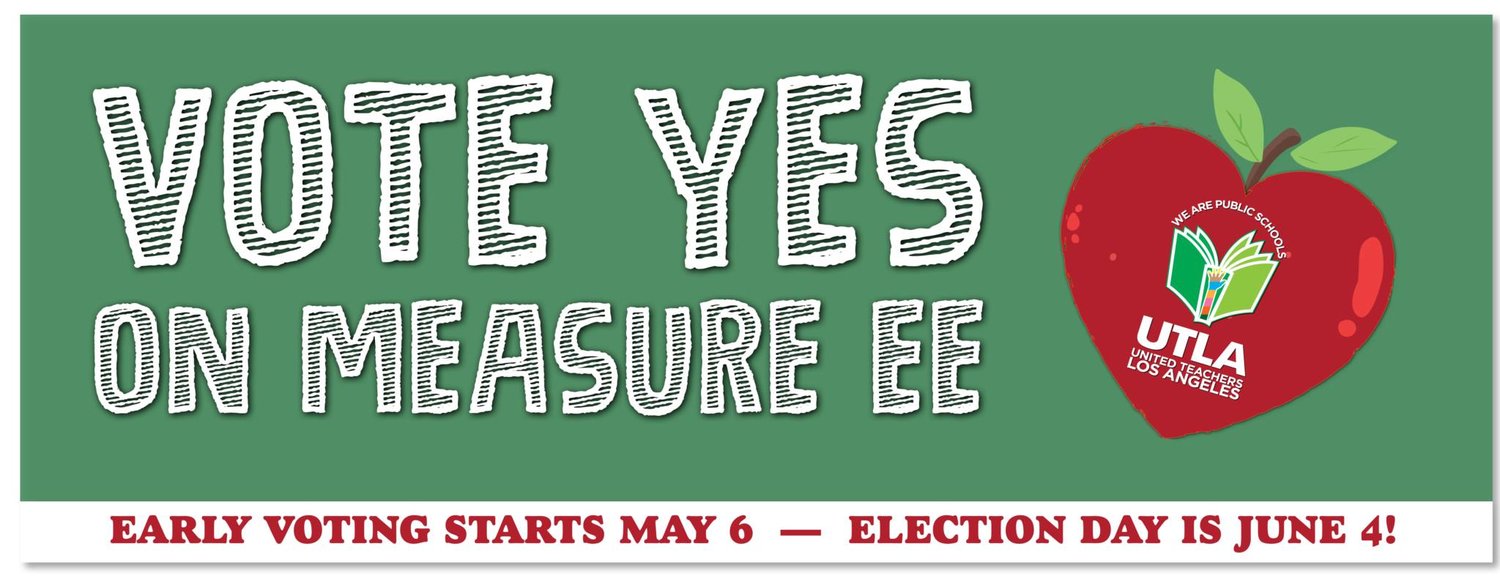
Passing Measure EE in LA would place a modest, $0.16/sqf progressive tax on property to fund public education in Los Angeles. A new tax in California can only pass with a super majority—we need every eligible voter to mail-in their ballot, or show up at the polls on June 4.
It takes courage, civility, and trust to vote for Measure EE. We can add value to public education in L.A., but we have to vote for it. This is for the future success of L.A.’s children and is particularly necessary in vulnerable neighborhoods.
Many people can find a thousand reasons to vote against any tax. It’s jarring to read unfair criticisms of LAUSD from opponents of Measure EE. They are telling us that money won’t help Education. Don’t believe your own eyes, they contend, money won’t help. What?? The truth is, big L.A. businesses don’t want to pay the progressive tax proposal on the ballot; the L.A. Chamber of Commerce instead suggested a ‘flat’ parcel tax, where large businesses would pay the exact same amount as a 900 square foot home. This is the definition of a regressive tax. This will no doubt be what big businesses will fight for, if Measure EE fails. This reminds us of the anti-tax tactics used during the 2016 primary, we had a Democratic staffer “inform” us that free college would hurt the poor. That’s anti-tax propaganda. Instead of providing support for our school system, and actionable solutions, opponents have resorted to demonizing LAUSD and Measure EE.
LAUSD needs money to hire teachers to reduce classroom sizes, and to hire more nurses and librarians, and create safer environments. Children need to learn in quiet and small classes, and frequently need new books. We can vote now by mail, or on June 4, to improve our entire public school system, and make it more accountable, Measure EE requires annual public auditing.
Our public school system in L.A is underfunded. New York and New Jersey public students receive twice as much funding per pupil as our public school students, and it shows. New Jersey has leading developmental teaching programs, as well as permanent nurses, school-provided tutors and staff. New York has built a record number of new schools and hired more teachers. Our children were safe and cared for in those healthy schools, funded by property owners, when we lived there for almost three years. This is why our family understands the incalculable ways that public school funding makes a positive difference for kids.
It’s time for us Angelenos to value education as much as the people in New York and New Jersey do, by paying property taxes. Because we are such a wealthy city, Measure EE is an opportunity for L.A. to elevate our education system with a modest tax that raises half a billion dollars each year. We don’t know of any other ballot issue that helps ease wealth inequality in L.A. Measure EE is a start. The Trump tax bill has given billionaires windfall tax breaks, and L.A. is one of the few places that billionaires can buy $6 million dollar homes. We need to vote to fund public education, because billionaires won’t.
City and State leaders, including Mayor Eric Garcetti, Governor Gavin Newsom, and U.S. Senator and Presidential Candidate Kamala Harris, support Measure EE as they know the acute need for additional funding for education. Opponents of EE have not put alternatives on the ballot, just critical opposition and denial of the transparent plan that was hammered out by teachers and the district, with help from the Mayor and the Governor. LAUSD is already showing their commitment to fiscal responsibility by contracting an extensive savings analysis of their budget with Ernst & Young. Although this plan puts LAUSD on better financial footing, the savings identified by Ernst & Young does not cover projected deficits, we need Measure EE to improve our schools.
Angelenos now have a chance to vote for substantive change, to begin solving one long-standing systemic problem: Underfunded schools in Los Angeles.
LAUSD is the public school system we have, so let’s come together as businesses, homeowners, and a city, and fund our public schools with a strong and healthy tax base.
We have a lot of work to do to improve the lives of all the people in our country, let’s start at home, let’s make history in L.A. and fund a new property tax on education.
Please Vote YES for better public education in L.A. Please Vote YES on Measure EE
I could not believe the news of the fire at Notre Dame cathedral. We visited it in 2014, and below are some pictures we took. I’ve also included some of the pictures from news orgs post fire for some perspective. We did not take pictures of the roof that was damaged, we just got the facade and a little of the interior.

Front of cathedral, looking at the iconic towers.

Close-up of the front main entry doors

Rose window on front facade

Inteiror of cathedral - we chose not to stand in the very long line to get to the front close to the altar.

Altar inside Notre Dame - the image is pixelated as I had to zoom since we were outside the area immeidately next to the altar.

Interior with holes in roof (photo credit Christophe Petit Tesson/AP)

Interior damage to Notre Dame (photo credit Christophe Morin/Bloomberg)

The interior burining (photo credit PHILIPPE WOJAZER/AFP/Getty Images)

Interior smoldering (photo credit PHILIPPE WOJAZER/AFP/Getty Images)

When the LAUSD and UTLA reached a hard-bargained for agreement this January, it provided for among other things, reduced class sizes by four students by 2021, 300 additional nurses, almost 80 librarians and 80 additional counselors. Part of the deal included support for a ballot measure to create a parcel tax for additional funding for LAUSD to help meet these commitments. This measure is slated for the June 4 ballot, and is labeled Measure EE.
Ballot Measure EE would create a parcel tax of $0.16 per square foot on properties within the district. This is estimated to generate about $500 million annually for LAUSD. The tax provides for exemptions for seniors and disability recipients. The text of the ballot is below, and can also be found here:
EE–QUALITY TEACHER, CLASS SIZE REDUCTION, AND LOCAL SCHOOL SAFETY MEASURE: To retain/attract quality teachers; reduce class sizes; provide counseling/nursing/library services, arts, music, science, math, preschool, vocational/career education, safe/well-maintained schools, adequate instructional materials/supplies; support disadvantaged/homeless students; shall Los Angeles Unified School District levy $0.16 per square foot of building improvements annually, exempting seniors/certain disability recipients, providing approximately $500,000,000 annually for 12 years, requiring annual audits, oversight, and funding local schools?
Public education is at the core of a vibrant, functioning democracy. With income inequality at record highs, it is more important than ever to ensure access to a quality education with reasonable class sizes, staffing of campuses with nurses, librarians and counselors, and fair pay for teachers. This is why it is dissapointing to see the L.A. Chamber of Commerce and VICA (the Valley’s business chamber) each oppose this measure. You can read the Chamber’s statement here, and VICA’s statement here. Their opposition appears to be grounded in the fact that the tax is based on square footage vs. a “flat” tax where homeowners and small businesses would pay the same tax rate as large mansions and large businesses.
Educating our children is a shared responsibility across all segments of our city. I urge our business chambers to reconsider their positions and support funding a quality education for our children. LAUSD and UTLA reached agreement on a path forward for our children, with the help of our city and state leaders, including Mayor Garcetti who supports this measure. There’s no question that additional reforms are needed - this is just a first step in moving forward to reforming our school system. However, starving our school district of funds is not the answer. Our city should follow through on this commitment to start down the path of providing a better education for our children. I am a parent of two children in LAUSD - let’s get behind our kids’ future - let’s vote YES for Measure EE.
I love taking photos out of airplanes. Snapped a few over LAX, EWR, and a couple on the way. Read on, especially the caption of the last picture of the 757-200 that I was on yesterday.

View of Marina Del Rey

Kalitta Air Boeing 747 taking off

Dusky cloud cover off the Santa Monica Bay

Snowy Rocky Mountains

Newark, NJ

Looking down the runway at EWR (Newark Liberty International Airport)

Dusky cloud cover over Oklahoma

The 909

United Boeing 787 Dreamliner

The actual plane I was flying on yesterday, a Boeing 757-200. Copyright Radim Koblizka; you can link to photo here, and see stats on this 29 year old plane here. Interestingly enough, the decision by Boeing to not produce a successor to the 757 had some bearing on United’s position regarding the 737 Max when Airbus came out with its new A320 and A321 neo planes. Boeing had to jerry-rig the 737 to be bigger, have longer range, have bigger engines, and hold more passengers. Kind of like the 757. Which is why airlines still use it 30 years later.
Six years before the Declaration of Independence, in which he wrote “We hold these truths to be self-evident, that all men are created equal, that they are endowed by their Creator with certain unalienable Rights, that among these are Life, Liberty and the pursuit of Happiness.”


It happened again. Stephon Clark was shot 20 times by police. He was unarmed. In his grandmother’s backyard. And no police accountabilty. He wasn’t just shot - he was shot after he fell to his hands and knees after the first volley of shots.
I understand the police have a difficult job. But they are entrusted with the ability to use state sanctioned deadly force. With that resonsibility needs to come accountabilty and oversight. This keeps happening to young black men - it won’t stop until we recognize it and demand accountability.
Black Lives Matter.
News broke that Israeli PM Benjamin Netanyahu is working to bring in Otzma Yehudit - a racist right wing political party - into the government. This, on top of the so-called “nation-state” law, puts the current Israeli government squarely in the zone of appearing to have no moral anchor. Mr. Netanyahu, you must go - you are hurting, not helping, the Israeli state. You are hurting the cause for peace. You look craven and desparate to hold power no matter the cost. No state should be sanctioning racism and de-legitimization of a people, especially one whose people have been on the receiving end of such treatment for millenia.
No, I am not kidding. Story in the Montgomery Advertiser is here.

I came across this Mother Jones article today, which lays out the number of federal judicial nominees from the Trump administration who refuse to acknowledge whether Brown v. Board of Education was correctly decided (there’s at least ten). Brown, you may remember, was the landmark 1954 Supreme Court unanimous decision that abolished segregation in schools. What could be an easier question? Even Brett Kavanaugh knew enough to acknowledge Brown is settled law. His replacement on the D.C. court of appeals apparently could not do the same.
I recently had the opportunity to visit the Atlanta Center for Civil and Human Rights, which is a remarkable journey through the key moments of the civil rights movement of the 1950s and 1960s. It is a powerful reminder of the terrible currents of segregation, hate and violence that existed in the 20th century. You can see the politicians that fought for segregation; read the Jim Crow laws that were in effect throughout the southern states; experience what it might have been like to sit in protest at a segregated lunch counter; understand the heroism and bravery of the Freedom Riders in 1961; learn more about the march on Washington for Jobs and Freedom and the acts of violence that followed it, such as the bombing of the 16th Street Baptist Church in Birmingham that killed four girls, the murders of James Chaney, Andrew Goodman and Michael Schwermer, and more. We hear about the legacy of Dr. King and his unflinching truthtelling in pursuit of economic and social justice. I walked out feeling more committed than ever to try to uphold that legacy in whatever small or large way I can. Two of people I was touring with - an industry colleague and her friend - are Black, and we exited the Center together, feeling like we had experienced a profound and moving place.
We encountered on the sidewalk just outside the Center a group of white street-preacher families, wearing matching t-shirts and smiles, everyone with genteel politeness and glossy brochures. These were not your doom-sayer corner screechers, just a bunch of folksy sounding families with some southern accents. A young girl with braces, probably around thirteen, with bright blue eyes and a big smile came up to the three of us and handed us a weighty metal coin. What I presumed was her family was sitting behind her, also with huge smiles. Me being me, I politely accepted the coin and I was super-curious about what this young lady had to say. The coin, by the way, had five Christian fish on it with various colors - gold, black, red, white and blue, along with some other attractive decorations.
The girl began her story by telling us about the story of Christ, and her joy about the knowledge that she going to heaven. All good and fine so far. She then asked me what I thought of the gold colored fish, what feelings did the color gold have for me. So natch, I said something like, “I suppose money or material things”. She approved of that answer and talked about the dangers of materialism as one might expect. Okay, again fine, no big deal.
Then she asked me what feelings I had about the color black, what it represents. I hesitated - I was pretty sure where she was going with this, and I had to take a moment to compose myself and figure out my response, especially given where we just came from. However, my colleague had no such hesitation when she said “Beautiful. Black is beautiful.” This young lady had zero idea of how to respond to this, I could see her processing how to deal with it. So she repeats the question to me, the white guy. “Yeah ok what do you think of the color black?” And I said “Me too, Black is beautiful.” The young lady at this point had recovered her composure and said, “Well yes but the color black represents darkness and sin, do you know what sin is? I mean black is darkness in the way Disney is, it represents sin.”
I said I had a pretty good idea of what she was talking about, and my two colleagues and I laughed and walked away. Afterwards, we talked about it for a bit, the fact that this girl had no clue that her words - in particular just outside of the Center for Civil and Human Rights - might be contributing to the concept that “black” = “sin” or “bad” could be construed to also be applied to Black people. It certainly was a very awkward and weird moment for all of us.
This seemingly small interaction happens every day all over the country. I’m not sure I would have thought much of it myself had we not just come out of the Center and I was with two Black colleagues who felt the same impact I did, assuredly much more so than me. And the mission creep of small, insensitive interactions is very deeply linked to the larger, more systemic attacks on civil rights that continues to happen in this country, and particularly under this so-called President. And so it is no accident that judicial nominees from the Trump administration are not validating Brown, thus accelerating the mission creep of systemic and institutional racism, across all people of color, religions, places of origin, gender identity, undermining the very concept of empathy and humanity.
So what do we do? The Rev. Dr. Martin Luther King said something about it:
Like a boil that can never be cured as long as it is covered up but must be opened with all its pus-flowing ugliness to the natural medicines of air and light, injustice must likewise be exposed, with all of the tension its exposing creates, to the light of human conscience and the air of national opinion before it can be cured.” Letter from Birmingham Jail Dr. Martin Luther King, Jr. April 16, 1963
I was on a plane this week sitting next to a very wealthy (white) man who was surprised I took the time to blog, tweet and speak out about what ails us today. My reply to him was “Why would I be afraid of talking about it? Why would you be? If we cannot talk to each other then where are we as people?” We too often let fear put us to inaction and silence. Donald Trump and his GOP enablers - and yes I am calling out the GOP - are what happens when inaction and silence occur. We cannot be silent any longer.

Evan Vucci/AP/REX/Shutterstock; MICHAEL REYNOLDS/EPA-EFE/REX/Shutterstock
A lot has been written about the recent proposal by the GOP & Trump to end the shutdown. It has angered Democrats as the protections would only last three years, and angered Republicans because the deal would dare to offer what they term as “amnesty”. I might be the only person in the country right now who thinks they need to cut some kind of deal on this to open the government, but I am making the case to do so here.
Right now, the Democrats are saying the deal is dead on arrival because a) the protections for DACA are temporary; b) any funding for the wall is wasteful and immoral; c) would enable Trump to gain a “win” on his signature divisive and hateful campaign rhetoric; d) would encourage Trump and the GOP to shut down the government each time a funding issue comes up; and e) the Ninth Circuit has paused Trump’s attempted recission of DACA and it doesn’t appear yet like the Supreme Court will take up the case this term. That’s a lot of cogent, articulate reasons, and I understand them all.
However, there are five things that make me believe that the Democrats should move forward with some kind of deal for DACA, if not the exact one Trump and McConnell have proposed. The first is that the shutdown is hurting a LOT of people, first and foremost the 800,000 federal employees who did not choose to participate in this exercise. It also is hurting our national parks, food safety, airport security, EPA inspections, abiltiy to manage taxes, and so on. I realize standing on principle is important, but at some level we really need to get the government back open. Yes, I know all the reasons for not doing this - rewarding bad behavior, giving Trump an exit, potentially not getting a “good enough” deal. Screw all of those potential fears - the GOP and Trump already look terrible, and opening up the government now doesn’t undo that damage. We should be in the business of governing, and there’s nothing that’s happened here that will make the GOP look good if the government opens tomorrow. We need to get our people back to work and get our country moving again.
Second I believe consideration of some legislative extension for DACA is actually a win, even if it only goes for a period of years. Let’s not forget, DACA was implemented via executive order, NOT legislation. As you probably remember from civics class, executive orders don’t have the force of law; they can be overturned and/or modified by future presidents, or Congress if it so chooses. That very fact is why Trump’s actions on DACA are being litigated across the country now. Democrats are quick to point out that the Ninth Circuit has put a halt on Trump’s attempted rollback of DACA, and that the Supreme Court is likely not willing to hear the case this term. So given the courts have put a halt on DACA rollbacks for maybe at least a year, what exactly would the Democrats be “winning” with a legislative fix? First and foremost, it would achieve some certainty for DACA recipients past the 2020 elections, and take the fate of Dreamers out of the hands of the courts. Keep in mind that advocates of relying on the court are saying in essence they are relying on the court of John Roberts to keep it in place. Do you want to take that bet? Don’t forget there’s another court case in Texas, Texas v. Nielsen that is still challenging the legitimacy of DACA as a whole. Legislative solutions are much more stable than ones imposed by the courts or the executive. As a matter of principle, we should always be wary of legislative dictates by the executive branch. Look no further than our current occupant of the White House - are we saying executive reach was okay under Obama, but not okay under Trump? Clearly our current situation makes that proposition untenable. Buying certainty for DACA recipients for at least three years for $5.7 billion? It doesn’t have to be the exact deal put on the table by the GOP - it may get better. Sign me up and we’ll figure it out over at least the next 36 months, and get people back to work.
Third, I realize the wall is a waste of money. And to be candid, it doesn’t really bother me all that much. There are SO many more wasteful items in a $3.5 trillion budget that get used to advance policy. In my opinion, spending a few bucks to shore up some holes or put a few slats up along the border doesn’t practically really do anything. Making the wall a hill to die on gives it prominence it really doesn’t deserve.
Fourth, after this debacle I don’t believe the GOP or Trump will have an appetite to engage in a shutdown fight again anytime soon. I could be wrong about this - but they look so bad right now I don’t think they’re going to do this again. Mitch McConnell is a bad person, as are his senatorial henchmen, but they are at their core polticians looking out for their own skin - they have to understand if they do it again will be so much more of a disaster than this one already has become.
Finally, a deal for DACA will in all likelihood split the GOP and create infighting over the next two years. Popcorn anyone? Time to get the deal done and get back to work.

I stand behind our teachers fighting against unreasonable class sizes, for students with special needs, staffing for schools and a reasonable pay increase. For the record, I do NOT support the independent charter movement, nor do I support the expansion of independent charter schools. I support public education, with public accountability - each and every one of us should be invested in ALL of our children’s futures. Our teachers educate and watch over our future - our precious children. I have seen a public school system work when it is fairly funded; it is a myth that public eduction can’t work. I really wish this was not going to happen, but our family is with UTLA.

It’s that good. There’s probably not much to say that’s not already been said. But I have to talk about it anyway. The music of course is dynamic, pulsing, dramatic, emotional and is the vehicle through which the story is told. As another review said, it is so much more than hip-hop; there are ballads (Dear Theodosia, Take A Break), blues/swing (What’d I miss), Showtune/Jazz (Room Where it Happens), broadway style (Story of Tonight), lots of driving hip-hop (My Shot, Yorktown), and some really cool indefinable, almost mystic moments (Satisfied).
But the genius of Hamilton isn’t just the music, storytelling and choreography - it is the fusion of these elements that brings the passion and ideological (if not fufilled in practice) genius of the American experiment into the modern age. Hamilton makes the American Revolution come alive in a way at least I’ve never seen before. For me anyway, the American Revolution has been shrouded in myth and contradiction no matter how much I have read about it. Here, the humanity of each of the Founders comes through through this modern telling of our story. We don’t just get to know the key characters in a fun and engaging way; we the audience are joining the revolution and experiencing all of its emotions and contradictions.
The first few songs introduce us to Hamilton and the passion and camraderie driven by the desire for freedom. We get a glimpse of the madness of King George III, followed by the bonding of Hamilton and Washington together in common cause. Throughout the production, the relationship between Hamilton and Washington is both at once human and transcendent. We get brought into the inner circle of Hamilton’s life with his intoruction to the Schulyer sisters, in the song Helpless. Angelica’s pain in Satisfied sears through us, her situation emblematic of the contradictions of the age and the revolution that promises freedom - but not for everyone. We see Aaron Burr advising Hamilton to “talk less, and smile more”, and wondering what drives Hamilton’s energy and success. When in the song Yorktown the words “ the world turned upside down” come floating from the stage after the battle has ended, it felt like we in the audience were also on the cusp of a new national adventure. I got goosebumps.
The musical then takes a new turn with Jefferson’s introduction and the debates that follow, which make the formation of the country come alive, between What’d I miss and Cabinet Battle #1. Burr’s longing for power comes through in The Room Where it Happens - in my opinion, one of the best moments of the whole musical, combining key elements of conflicting storytelling, politics back room dealing and how deals get done. One of Hamilton’s last great political acts was to help George Washington talk to the nation, highlighted by One Last Time, in which Washington and Hamilton teach the country “how to say goodbye.” What follows are a series of tragedies and setbacks to Hamilton’s life, including his affair with Maria Reynolds and subsequent revelations that prove disasterous to Hamilton’s poltical career. Without Washington as a ballast, Hamilton makes poor judgments in his life, and ultimately winds up in his fatal duel with Aaron Burr.
Contradictions are the hallmark of Hamilton; the diverse cast, along with modern music puts the contrast between the words of the Declaration of Indepencence and the Constitution, and the lack of freedom for many people in the new republic in full, unvarnished view. But the ideas propounded by the Founders still ring true and come through in Lin-Manuel’s telling of our story, reminding us of the America that we still can strive to be. I truly believe this is one of the great works of art that will be produced in our lifetimes. I’ll leave you with my favorite song, Yorktown, if you haven’t listened then I would say you’ll feel like you won the revolution after you do.

I read The Fifth Risk two consecutive times, it is that good. I couldn’t help it - what I thought I knew about how our government works is well short of what I actually did not know. And current administration poses unique risks to our government that may not be as obvious to most of us. That was certainly true for me.
The title may make it obvious, but this book is about risk. And it starts, oddly enough, with Chris Christie. As Trump became the GOP nominee, Christie winds up getting himself appointed as chairman of Trump’s transition team - the team that is tasked with staffing up the government, making recommendations for appointments and getting briefings on how the government works. And at least in Michael Lewis’ telling, Christie hires a whole team and does a credible job of pulling a lot of this together.* When Trump was elected, however, Christie was fired from his job - the Trump team tossed out all that work and chose to go into governance essentially blind.
The U.S. government has the largest risk portfolio on the planet - managing and trying to mitigate significant risks that people could be harmed by. The first risk mentioned in the book is a nuclear accident. The second is North Korea. The third is Iran, and the fourth is the safety of the electrical grid. The fifth risk is described as “project management”. Lewis encapsulates the fifth risk by saying “The risk we should fear most is not the risk we can easily imagine. It is the risk we don’t.”
Well, what is project management, you may ask? Lewis starts with the Department of Energy - the DOE. Did you know the DOE is responsible for maintaining the U.S. nuclear arsenal and half of its budget goes to that? You know what else the DOE does? It cleans up the nuclear waste that was produced by making all those nuclear weapons; a quarter of the DOE budget goes to that. (The bomb dropped on Nagasaki had 14 pounds of plutonium, but generated hundreds of millions of gallons of radioactive waste. Turns out the U.S. produced at least 444 billion gallons - yes billion - of waste that was put into the ground.) There was no transition team from the Trump administration to learn what the DOE did and managed. None. Except some people asking for a list of employees who had previously worked on climate change. In fact, Rick Perry, who wound up being the head of the DOE, famously said he would eliminate the DOE altogether (of course that was before he became its secretary). You start to realize why Rick Perry as head of the DOE might be a problem. Not just that, but Trump has also proposed cutting funds to cleanup nuclear waste. If you feel like it, search up Hanford, WA, nuclear waste. Project management indeed.
Lewis goes on to describe other functions of government and the risks of not properly understanding (or not caring) what the government does, such as the Department of Agriculture. Agriculture includes the USDA, which inspects all animals for human consumption. The Dept. of Agriculture also fights wildfires, oversees the national park system, manages school nutrition programs and food stamps. There’s a $200 billion bank for rural development, a science lab and a host of other functions.
There’s also the Department of Commerce, and you could be forgiven if you did not know it was responsible for the National Weather Service and NOAA. If you don’t know what NOAA is, look it up the next time a hurricane comes by the United States.
The other aspect about this education I received is an understanding of the incredible trove of data that the U.S. government is sitting on, that could be used for really beneficial purposes. For example, it was Pro Publica accessing patterns of opioid use and deaths that brought the opioid epidemic to the forefront of public discussion. The government has systematically been removing public access to all kinds of data, whether it be related to crime and police patterns, climate data, data on animal abuse just to name a few. Additionally private companies such as AccuWeather, whose CEO Trump nominated to head NOAA (confirmation failed by one vote), continually press the government to limit the public’s access to NWS weather data so that these private companies can charge for it. Michael Lewis succinctly points out that what you don’t know, the things you don’t learn, are the things that can bring the highest risk.
All of this is not to say things are hopeless - Michael Lewis goes out of his way to bring attention to the committed civil servants who are working on behalf of their country, and are doing their best to keep doing their jobs. But what he does say is that elections have consequences, even ones that might not have actually been intended by some folks. We should all read this book to get a better understanding of how our government is actually working, and how we as a citizenry can and should make informed decisions about whom we vote for, because it matters.
*I lived in New Jersey for almost three years. Chris Christie is a no good, dirty, mean politician. But he did understand the levers of government.
There’s a lot that’s happened this week. Midterms and Trump’s press conference meltdown. Another mass shooting. Multiple fires in California. The firing of Jeff Sessions only to be replaced by a shady operator that opposes the Mueller investigation. And oh by the way, on the way out Sessions signed a last minute memorandum limiting the Justice Department oversight of police abuse. Trump suspending all asylum rights for any undocumented immigrants fleeing their country. I’m sure I’m missing more.
Feels like we’re going off a cliff a little bit.
But I do take some heart in the outcome of the midterms. If you just take a moment to breathe, the Democrats took control of the House and seven - yes seven - governorships. Ohio and Florida were heartbreakers - assuming the called results in FL still stand - but were really close, as was of all things, Texas.
I was talking with a good freind of mine, and he got me into a better place by explaining that with those margins, Ohio and Florida are actually flippable in 2020 with the right candidate. Barack Obama won both states both times. But - you really need Ohio, which let’s not forget re-elected Sherrod Brown. if you take the states that Obama won, subtract FL and VA, you still get to 290 votes and a win. So - the issue is less about the fact that OH and FL went slightly Republican this time - the issue is about who will be the candidate that can take these states and flip them to the blue column.
For the record, it is true I natrually gravitate towards Democrats; my views are more often than not closer to Dems than Republicans. But I don’t have a problem with conservatives per se; as I’ve said in a previous post, conservatives - real ones - provide a natural ballast to debate. After all, no one is always right, and everyone can have boneheaded ideas. My problem is the current Republican Party and its support of Trump and Trumpism. And a majority of the country also has a problem with it. Which means in 2020 there’s a real shot at taking this country back from Trump. The 2018 midterms are actually a great start in that direction. Let’s keep that momentum going!

So much has happened in such a short time. The pipe bombs sent to critics of Donald Trump, the racially motivated killing of two black people at a Kroger grocery store in Kentucky, the purging of 340,000 voters in Georgia by its Secretary of State - who is running for Governor against Stacey Abrams. And of course, the horrific massacre at the Tree of Life synagogue in Pittsburgh.
I have had a lot of trouble getting through these past weeks with my mental sanity intact. A good colleague and friend wrote me today, and spoke to the importance of character. And his words reminded me of the Reverend Dr. Martin Luther King’s famous words: The ultimate measure of a man is not where he stands in moments of comfort and convenience, but where he stands at times of challenge and controversy.
If you view yourself as a conservative, I ask you to hear those words from Dr. King, and not just speak out to offer thoughts and prayers, but to demand accountabilty from our leaders, and that we bring America to its best possibilties of equality, civility, freedom and hope instead of division, discrimination, violence and fear. I would say to not fear real liberals, for they can be a catalyst for positive change.
If you view yourself as a liberal, I ask you to hear those words from Dr. King, and keep an open mind to listen and invite a real dialogue with people who may not always agree with you on issues, but do care about America being its best self. I would say not to fear real conservatives for they can help keep the ballast for our great ship of freedom.
If you are neither, and fed up with our political mess and are staying out of it - well then I ask you to now step in and help bring our country to its best self. Because what is happening right now is not working.
There’s a quote from Barack Obama back from 2006 about our politics - that “there was and always had been another tradition to politics, a tradition that stretched from the days of the country's founding to the glory of the civil rights movement, a tradition based on the simple idea that we have a stake in one another, and that what binds us together is greater than what drives us apart, and that if enough people believe in the truth of that proposition and act on it, then we might not solve every problem, but we can get something meaningful done.”
This is what we must do - we must be invested in one another, and believe in that truth that what binds us together is greater than what drives us apart. Next week we find out whether we can validate that truth.
I would like to close this post with a prayer for peace; it was one of the first prayers I learned as a child, to this day it is my favorite prayer and it still gives me hope. May God bless not just those killed in Pittsburgh, PA and Jeffersontown, KY, but all of our brothers and sisters killed in the hateful violence that has been afflicting our nation.
Oseh shalom bimromav, Hu yaaseh shalom aleinu, v’al kol Yisrael. V’imru: Amen.
May the One who makes peace in the high heavens make peace for us, for all Israel and all who inhabit the earth. Amen.


Let me start by saying that this book is not her MSNBC show. It is a thoughtful and detailed explanation on how America has unmoored itself from its own military, and removed the built-in disincentives that were intentionally designed to make going to war difficult. People may be surprised that she goes back to first principles expressed by the Founders, something commonly attributed - wrongly - as just a conservative perspective, but that is what she does.
Maddow quotes James Madison as saying “The Constitution supposes, what the History of all Governments demonstrates, that the Executive is the branch of power most interested in war, and most prone to it. It has accordingly with studied care vested the question of war in the Legislature.” And yet, since the end of the second world war, there has been an ever increasing push for warmaking decisions to reside in the executive branch, with Congress abdicating its Constitutional right and duty to evaluate when armed conflict is called for.
Article 1, Section 8 of the Constitution grants Congress the express power to declare war. (Side note for good measure, the Tenth Amendment says “The powers not delegated to the United States by the Constitution, nor prohibited by it to the States, are reserved to the States respectively, or to the people.” So there’s no inherent power in the executive to declare war. While the President is the Commander in Chief of the armed forces, the power to declare war is expressly delegated to Congress by the Constitution.) Maddow takes us through the unchecked expansion of executive power from the Korean War through Obama’s conflicts, with each one expanding the concept of presidential war-making authority without Congress.
The Korean war was the first major undeclared war fought by the United States, and Vietnam was based on the flimsy Gulf of Tonkin resolution. It was, however, Ronald Reagan’s decision to invade Grenada as well as his illegal venture into the Iran-Contra scandal - where the Reagan administration sold U.S. weapons to Ayatollah Khomeni to fund “Contra” fighters in Nicaragua - that accelerated the disconnection of war from Congress and the American people. One of the major differences between the Korea and Vietnam conflicts from wars after that was in Korea and Vietnam, large numbers of reserves were called up to fight - making the American people intertwined into these conflicts. It was the Reagan administration (in particular theorized by Ed Meese, Reagan’s attorney general) that espoused the theory that the President does not need the authority of Congress to start a war.
It is true that both Iraq wars and the Afghanistan war were ultimately authorized by Congress. But Iraq 2 was based on false premises (weapons of mass destruction anyone?) and once those premises were discovered to be false, the President chose to redefine the mission and keep troops there potentially indefinitely. Additionally, the war in Afghanistan was to retaliate against the Taliban and Osama bin Laden. Again, it was the President that changed the mission and turned it into the endless and fruitless nation building exercise that it has become. Obama armed and supported Syrian rebels, decided to intervene in Libya (but not Bahrain), expanded CIA drone strike operations. And so on. Congress has had the power to oversee and end these military endeavors and chose not to do so.
Back to privatization for a moment - starting with Grenada on a small scale, and embraced by subsequent presidents, many functions that used to be done by military personnel have been privatized (often in conjunction with the CIA), reducing accountabilty, oversight and impact that war has on families not directly connected to the volunteer military. These contractors are, as Maddow highlights, not exactly the people we would want representing America. Additionally, we get a view of while we spend ever increasing sums of money on military budgets, we don’t exactly take care of the military hardware we do have - in particular the neglect afflicting the U.S. nuclear arsenal. (For a more detailed and terrifying view of the state of America’s nukes, I recommend Command and Control by Eric Schlosser.) This all of course comes at a price - our constant state of war, our exploding deficits, the diversion of resources to domestic growth, such as infrastructure, research & development, health care, etc.
We are reminded that it is not too late, that we as Americans can insist on accountabilty at the ballot box. We must demand that our leaders stay true to the values of the Constitution - that the country and the decision to enter a war is bigger than just the executive. The primacy rule of law is what makes the American experiment truly exceptional. I will close by restating that this book reflects Rachel Maddow’s best stuff, showing us the Oxford Rhodes scholar that she is.

Yesterday I published my CA statewide ballot initiative recommendations for the upcoming election on November 6. Today’s list endorses state and local office candidates, as well as upcoming LA City Charter Amendments. Remember to vote November 6!
Governor - Gavin Newsom. Newsom’s public positions on civil rights, health care, immigration rights and environmental issues make him my choice for governor. Given today’s political climate and the GOP’s continued loyalty to Donald Trump, I do not believe California can afford to vote for John Cox.
United States Senator - No endorsement.
Lt. Governor - No endorsement.
Secretary of State - Alex Padilla.
Controller - Betty Yee.
Treasurer - Fiona Ma.
Attorney General - Xavier Becerra.
Insurance Commissioner - Ricardo Lara.
State Board of Equalization 3rd District - Tony Vazquez.
United States Representative, 30th District - Brad Sherman.
CA State Senator, 18th District - Bob Hertzberg.
CA State Assembly, 46th District - Adrin Nazarian.
CA Supreme Court and Appeals Court Justices - LA Times has an overview of why to vote yes for these justices.
LA County Measure W - YES. Measure W is a $0.025 parcel tax per square foot of “impermeable area” to capture and cleanup storm water. There are credits available to properties that address stormwater runoff. The LA Times doesn’t have an endorsement on it as I can tell, but it does have a good overview of it here.
LA City Measure B - YES. This measure gives LA the right to create a municipal bank. Now y’all might think I’m nuts for voting yes, and maybe I am. After all, there’s really no parameters set for the creation and management of such a bank. Additionally, a municipal bank might be subject to influence and benefit local special interests, such as developers. Politicians may try to use the bank to influence and gain favors. As well as push for investments that benefit political donors. And yet, the prospect of local banking and capital management might actually lead to more investment in Los Angeles. A bank of Los Angeles that has local influence and local incentives might actually work for the benefit of Los Angeles residents, much in the way that employee federal credit unions try to work for the benefit of the employees of a company. it may spur more investment in local housing. If a bank of Los Angeles can open up doors to more investments in housing, transportation, and infrastructure with public accountability then I’m for taking the risk.
LA Measures E and EE - YES. These measures align LA City and LAUSD election dates to the state’s primary election dates. This will help boost voter turnout.

Once again, it is time for the Valley Dude’s election recommendations and endorsements! Statewide ballot recommendations are below:
California Statewide Initiative Recommendations
Proposition 1 - YES. Proposition 1 is a $4 billion bond measure to fund affordable housing solutions. As I read the initiative, it breaks down the funding into a number of components:
$1.8 billion to build or renovate rental housing projects such as apartment buildings. This would come in the form of providing local governments, nonprofit organizations, and private developers with low-interest loans to fund part of the construction cost. In exchange, projects must reserve units for low-income households for a period of 55 years.
$450 million to build housing near urban transit centers.
$450 million to encourage home ownership for low income buyers, priomarily by down payment assistance through low interest loans and grants.
$300 million for housing for farmworkers.
$1 billion for home loan assistance for veterans.
I must admit, I do have some reservations about this measure - in particular, how will the state administer who receives the funding as well as it is unclear to me what percentage of housing built actually would be reserved for low income residents. That being said, given the acute affordable housing problem in CA, as well as the benefits for veterans, bring me to a yes vote on Prop 1.
Proposition 2 - YES. Currently, about $1.5 to $2.5 billion per year is raised for mental health services and treatment through a 2004 initiative called Prop 63, which imposes a tax on incomes of $1 miillion and above. Proposition 2 would enable $140 million per year of this money to be used to pay for a separate issuance of $2 billion in bonds designed to build housing for those with mental illness and are homeless. There is currently litigation occurring that asserts that Prop 63 funds cannot be used to facilitate housing, only mental services and treatment. This proposition would resolve that dispute and permit Prop 63 funds to be used to pay for the $2 billion housing bond. This seems like a good idea, and another small step in addressing our homeless crisis.
Proposition 3 - NO. Proposition 3 authorizes almost $9 billion in bonds for water projects. Candidly I’m having a lot of trouble digesting a bond measure of this size when two water bond measures were recently approved, Prop 68 this June, a $4 billion parks & water bond (of which 1/3, or about $1.3 billion, was allocated to water), as well as Prop 1 in 2014, a $7.5 billion water bond. Since 2000, voters have approved about $31 billion in water bonds (including the above two bonds) of which about $10 billion is still available to spend. Finally, this Mercury News article gives a good overview of how one person primarily put the bond on the ballot, vs. other water bonds having more public debate. This one smells like a no.
Proposition 4 - YES. Authorizes $1.5 billion in bonds to improve California’s designated children’s hospitals. I can probably spend days writing about how screwed up our health care system is. It’s sad that our state of affairs is such that we are being asked to vote on whether to borrow money to finance health care facilities for children. That being said, we are where we are and existing improvement funds are apparently almost used up. So I’m voting yes.
Proposition 5 - NO! Proposition 5 is a terrible idea. Prop 13 currently lets homeowners over 55 (or who are disabled) keep their artificially low tax assessment when that owner sells and downsizes to a less expensive home. And that exemption can only happen once, the idea being that older folks who want to downsize for income, space, or other reasons are not subject to a Prop 13 tax reset. Prop 5 would permit such homeowners who buy a more expensive home to also keep an artificially low Prop 13 tax assessment. And this can happen an unlimited amount of times. Prop 13 itself has created a lot of fiscal problems for the state, burdening income and sales tax rates, while depriving schools and other essential services of revenue. This just exacerbates the problem in a patently unfair and unjust way. This is an emphatic NO.
Proposition 6 - NO. This proposition repeals the gas tax passed in 2017 to fund much needed transportation infrastructure across the state. Don’t vote for this. We need this funding for our roads, bridges, and tunnels. Remember the Minneapolis bridge collapse 10 years ago? How about the bridge collapse in Genoa, Italy just this year? I used to cross the George Washington Bridge into Manhattan every day, I literally saw the concrete crumbling increase on a daily basis. Vote no.
Proposition 7 - NO. This would put California on permanent daylight savings time. Uh, no.
Proposition 8 - NO. At first glance, this seems like a proposition to vote yes for - after all, who would not support limiting the cost of kidney dialysis? The proposal limits dialysis center revenues to 115% of “allowable costs”. Anything above that gets rebated to the payer of the procedure. Seems like a good idea right? So it’s really tough to offer up a no recommendation here. But here’s why - at least as I read it, a) there’s a huge amount of uncertainty as to how this thing would work, and b) when the payer is Medicare, Medical or a government entity, it appears these entities do not get a rebate.
On the uncertainty side, the measure says it caps revenues at 115% of allowable costs. But these costs have not been specifically defined beyond some examples given such as staff wages are permitted under the calculation of costs but not administrative overhead. It seems the California regulator and the courts would have to promulgate and interpret what these costs would be. Additionally, there’s some arbitrage that could occur - dialysis companies could increase allowable costs thus increasing permitted revenues. Or they could cut non allowable costs, but if overhead admin is not allowable that seems like it might be a problem (e.g., you have to pay your lease, power bill and your office manager). There’s also the bit where the proposition questions its own constitutionality as a potential government taking without just compensation and provides for an adjustment mechanism to get itself into compliance.
On the rebate side, and maybe I’m mis-reading the CA state legislative analysis, but the text of is below, and it really does look like Medicare and government entities do not receive rebates. In fact, if the dialysis companies increase allowable costs to increase revenues, then payers including Medicare are on the hook for higher costs as well which might lead to higher premiums. So all downside for Medicare et. al., while insurance companies get the upside. The whole thing seems really off.
In 2019, the measure requires CDCs each year to calculate the amount by which their revenues exceed a specified cap. The measure then requires CDCs to pay rebates (that is, give money back) to payers, excluding Medicare and other government payers, in the amount that revenues exceed the cap.
Finally, legislating costs via the ballot for one medical procedure seems really odd - something isn’t quite right about this. It’s true we need serious reform of our health care system. This ballot measure is evidence of precisely why we need a true single payer system both statewide and nationally. This type of measure on the ballot is truly symptomatic of how screwed up our system is.
Proposition 10 - YES. Currently the state prohibits local municipalities from regulating rent control for buildings built after Feb. 1, 1995, as well as all single family homes. State regs do require that existing rent control regs also permit a fair rate of return to a landlord. Proposition 10 would repeal the state prohibition on rent control and permit localities to impose rent control for their communities, but still require a fair rate of return for landlords. Vote YES for returning rental housing policy to cities and counties.
Proposition 11 - NO. Proposition 11 would relieve ambulance companies of the obligation to provide uninterrupted work breaks and meal breaks as required by law. Until a 2016 CA Supreme Court decision overturned the practice as a violation of labor law (Agustus v. ABM Security Services), ambulance companies would require employees to be on call during work breaks and meal breaks. Proposition 11 would permit ambulance companies too get around labor law and re-instate the practice. Ambulance crews typically work 12 hour shifts. The companies maintain this practice to reduce labor costs. The price of course is crews that don't truly get rest breaks. Vote NO on this end-run around labor law.
Proposition 12 - YES. Proposition 12 would expand space requirements for confinement of farm animals. As a point of order, I really hate legislating this kind of stuff at the ballot box. But if you're asking me to vote on whether to require more humane animal farm practices, then I'm going to say yes.

Jerry Brown signs California Homeowner Bill of Rights (July 10, 2012 - Source: Justin Sullivan/Getty Images North America)
It has been a little tough to gin up the will to write lately, the overwhelming volume of information and craziness has put my head into a place where I have needed to just stop, think and collect myself, to keep me from going a little insane. The Kavanaugh hearing reminds me that there are other means besides the courts to achieve social justice, such as state, local and federal legislation.
But I do need to take a moment to talk about the court and the current proceedings. For the record in my opinion, Kavanaugh appeared to show exactly who he is, belligerent, angry, partisan. He certainly likes beer. I understand he does not like what is happening at the moment. But the fact is that Dr. Ford has made an allegation, and she appears credible. Blaming Democrats, the Clintons, and “the left”, and attacking the process as a disgrace does a great disservice to a woman coming forward with her story. If it did not happen then Mr. Kavanaugh should welcome an opportunity to clear his name rather than go on the attack. This looks like the same guy who refused to shake Fred Guttenberg’s hand. (Mr. Guttenberg is the father of a child killed at Parkland.) He does not appear to have the temperment we would expect out of a Supreme Court justice, or any judge for that matter.
This is not to say that Mr. Trump should not get to make another conservative pick for the Supreme Court. Elections matter, and presidents get to pick their nominees. I do think it unfortunate, however, that the filibuster was eliminated for federal judges (done by the Democrats in 2013) and Supreme Court Justices (done by the GOP in 2017). Without the filibuster, presidents are free to nominate ideologues, and in this case, a nominee whose character is in question.
Be that as it may, a very strong possibility still exists that a Trump appointed nominee makes it on to the court by the end of the year. Even if Kavanaugh’s nomination is pulled, it is likely the Senate rushes through another confirmation, even if during a lame duck session post-November (remember Gorsuch had no such allegations). Which brings us to a reminder about the role of the courts.
The Supreme Court is not and should not be the only recourse for change, whether on social, economic or, civil rights. The court is necessary at times to push through certain walls - Brown v. Board of Education is of course the seminal example. But the court can go the other way as well, whether way back in Dred Scott and Plessy v. Ferguson (which Brown overturned), or more recently, Citizens United v. FEC (prohibiting regulation of corporate political spending) and Shelby County v. Holder (invalidating portions of the Voting Rights Act of 1964). Justice Kennedy swung the court in favor for equal rights for marriage equality in Obergefell v. Hodges on a 5-4 vote, but Kennedy also wrote the opinion in favor of the Colorado baker who did not want to make a cake for a gay marriage (Masterpiece Cakeshop v. Colorado Civil Rights Commission). And now Kennedy is off the court. As such, Justice Kavanaugh could start to peel back LGBTQ and other rights in the same manner that the rights conferred by Griswold v. Connecticut (right to privacy) and Roe v. Wade have eroded over time as the Supreme Court’s makeup changes.
All of this is to say it’s not just elections for President matter - they do - but pressure and actions by legislatures - local, state and federal - can and should work in as an agent for change instead of solely being reliant on whether the court has five votes. This has always been the case, but it seems in our recent history the court has taken an outsized role in this area post 1960s civil rights legislation. Our most basic protections are codified in civil law - the Constitution and all of its amendments, the Voting Rights Act, Civil Rights Act, Americans with Disabilities Act, and so on.
Where I may have some potential optimism is that there are a lot of energized people who can pitch in and make a difference outside of the courts. We need to make sure our states protect the rights of LGBTQ, women and immigrants, implement criminal justice reform, protect the environment, incentivize and/or build affordable housing, and ensuring civil rights including the right to vote. It is our responsibilty to elect legislators and hold them accountable for this progress. If the river of progress is dammed up by one avenue, then we must guide the water through another path.