
Elizabeth Warren poised to chair Senate Banking Committee. This is good news
Despite what the Wall Street Journal and other outlets may have you believe, Elizabeth Warren is a capitalist - she just believes free markets should be fair and open. This is one of her signature quotes, said during an interview with CNBC:
“I am a capitalist. Come on. I believe in markets. What I don’t believe in is theft, what I don’t believe in is cheating. That’s where the difference is. I love what markets can do, I love what functioning economies can do. They are what make us rich, they are what create opportunity. But only fair markets, markets with rules. Markets without rules is about the rich take it all, it’s about the powerful get all of it. And that’s what’s gone wrong in America.” - Elizabeth Warren
The key here is “fair markets, “markets with rules.” What does that mean? It means driving public policy through appropriate regulation for a specific outcome - in this case, the specific outcome is fair and free markets. This is NOT “socialism”, although there can be socialist sub-policies such as Social Security (it’s in the name!) and Medicare. This is creating conditions to make it more difficult for monopolies to take over.
My household talks a lot about the tension between where the right line is between public service vs. private enterprise, and what the right policy is. You need free enterprise and true competition to support a vibrant democracy; monopolies and/or a handful of oligopolies are destructive to choice, competition and security. There are also certain categories of industry that should be not for profit and/or tightly regulated to avoid exploitation, corruption and decay. So how would you take steps to achieve this balance? Some thoughts on this:
Overturn Citizens United v. FEC which gutted campaign finance rules relating to corporate political donations, opening the door for a torrent of corrupting political spending. Think about it for a minute - Elon Musk spent half a billion dollars to try to influence the 2026 midterms. Americans rightfully said no to this, but it took a generational political tidal wave event to overcome it. This gusher of political money puts tremendous pressure to oppose regulation of industry and needs to be removed.
Enforce existing anti-trust law. Monopolies are destructive to free enterprise and our economy. Consider something like Uber - which created a de-facto monopoly in ride sharing and destroying the taxi industry. It now often costs more to go to the airport in an Uber than it does in a taxi, and with fewer taxis your options are much more limited. I highly recommend Cory Doctorow’s book “Enshittification” which is enlightening on how companies move from what seems like a consumer friendly proposition to anti-consumer in very short order.
Certain segments of industry should be non-profit or tightly regulated. Consider health care, where we have the highest costs in the world and poor outcomes. WSJ, of all publications, highlights one of the problems with our current system - wait times in the ER now can be 24 hours. This is because in part people cannot afford insurance and/or pay to see a doctor, and the ER is the only place where providers are required to treat regardless of ability to pay. Or defense, where publicly traded companies are incentivized to push for sales of arms to countries around the world that may not necessarily be in the national interest, or continue arms programs that no longer serve our defense goals.
So what does some of this look like in practice? With Citizens United, this requires significant Supreme Court reform and/or a Constitutional Amendment. For anti-trust, this means the FTC and the DOJ bringing anti-trust litigation against monopolies, and reviewing proposed mergers with a much higher degree of scrutiny than has been done for the last half-century. For health care, this could be achieved with a single-payer system, and for defense this could transition into not-for-profit entities engaging in production. These are just some ideas, and I’m certain there are other good ones as well.
You will hear opponents of Warren say stuff like “Government should not put its hand on the balance of free markets” but government does that already. We have rules that protect corporations from liability, rules that provide favorable treatment to Wall Street, rules that permit unlimited sums of money to be spent on political campaigns and so on. The government puts its hand on the balance of monopolies and corruption. It should shift that weight to rules around fair and free markets.
I for one, am looking forward to how Senator Warren will put the spotlight on what the rules of the road are today, and what they could be tomorrow. P.S. I campaigned for Warren in 2020 :)
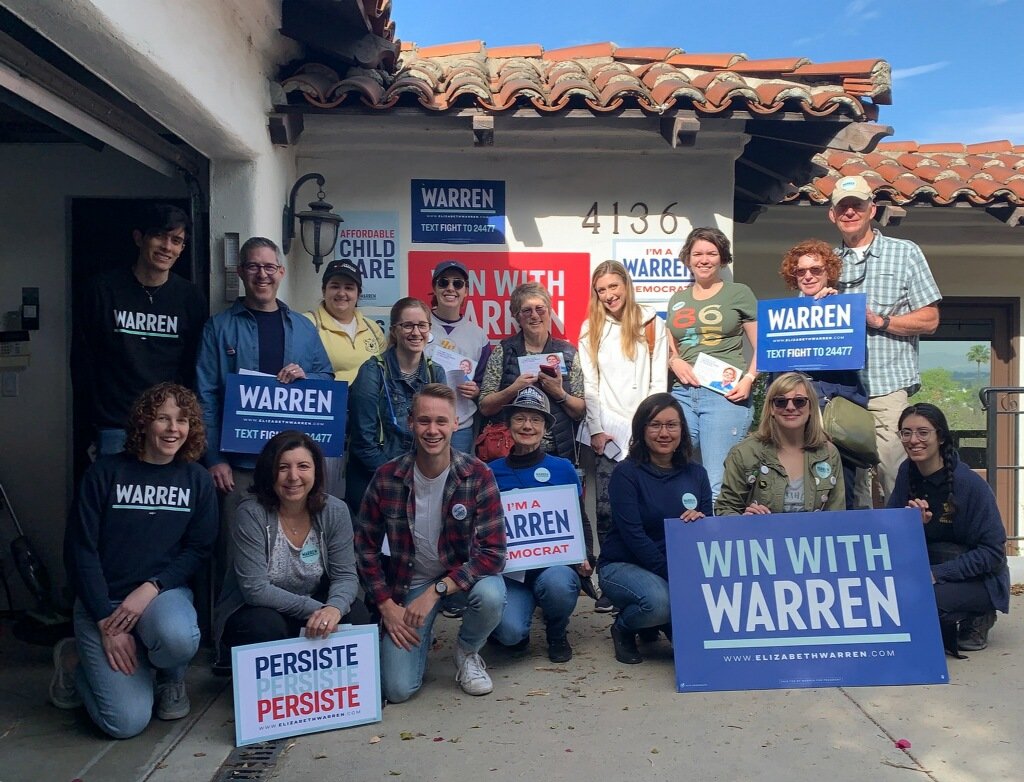
That’s me second from left in the back row!